Cold water immersion is one of the few recovery products with a real research literature behind it — and one of the easiest to overstate. The gap between what a study measured and what a sales page claims is where brands lose credibility with informed buyers.
This is a plain summary of what the physiology and the clinical literature support, written for the brands, distributors and facility operators who buy cold plunge equipment.
The first thirty seconds
Entering water below about 15 °C triggers the cold shock response: an involuntary gasp, hyperventilation, a rapid rise in heart rate and peripheral vasoconstriction as the body tries to preserve core temperature.
The response is strongest on entry and reduces as the body adapts. It is also why entry technique and supervision matter, and why the first seconds are the period most associated with risk in people with cardiovascular conditions.
The physiology is well described in the cold-water immersion literature; Tipton's work on the initial responses is the standard reference.
What the evidence supports
The best-supported use is post-exercise recovery. A systematic review and meta-analysis by Machado et al. (2016) found that cold water immersion in the 10–15 °C range for 10–15 minutes reduced muscle soreness compared with passive recovery. A separate meta-analysis by Higgins et al. (2017) reached a similar conclusion for team-sport recovery.
Perceived soreness and measured performance are different outcomes. Water immersion has been studied for both; the effect on soreness is more consistent than the effect on subsequent performance, and the practical recommendations in Versey et al. (2013) reflect that difference.
Where the evidence is thinner
Claims about immunity, detoxification, fat loss and systemic anti-inflammatory effects are common in consumer marketing and much weaker in the literature. The most cited immunity study — Kox et al. (2014) — involved twelve trained volunteers practising a specific breathing and cold-exposure protocol, and measured the inflammatory response to an experimental endotoxin challenge. It is an interesting result from a small sample, not evidence that ice baths strengthen the immune system in general.
Detoxification has no physiological mechanism behind it. The liver and kidneys do that work; cold water does not flush toxins out of the body.
One finding that matters for strength athletes
Cold water immersion immediately after resistance training can blunt the anabolic response. Roberts et al. (2015) found that post-exercise cold water immersion attenuated acute anabolic signalling and long-term muscle adaptations to strength training. For hypertrophy-focused programmes, that is a reason to separate the cold exposure from the training session or to use it on recovery days.
Dose: what the studies actually used
| Variable | Common in recovery research | What it means for a facility |
|---|
| Water temperature | about 10–15 °C | A setpoint in this range is defensible and repeatable |
| Immersion time | about 10–15 minutes | A timer is part of the protocol, not an accessory |
| Timing after exercise | often within an hour | Decide the policy and write it down |
| Frequency | varies by study | Do not present a research protocol as a universal prescription |
These are research protocols, not a public safety standard. Beginners should start shorter, and cold exposure should be supervised in a commercial setting.
Writing claims that survive scrutiny
| Overclaim | Defensible version |
|---|
| Cures inflammation | May reduce perceived muscle soreness after exercise |
| Boosts immunity | No established evidence for a general immune effect |
| Detoxifies the body | No mechanism; remove the claim |
| Burns fat | Not supported by cold-water immersion research |
| Speeds recovery | May support recovery; effects vary by protocol and outcome |
What this means for equipment
If the benefit depends on a repeatable dose, the equipment has to deliver a repeatable dose: stable temperature, a timer, a lockable setpoint and water clean enough to immerse in. That is a specification argument, not a marketing one.
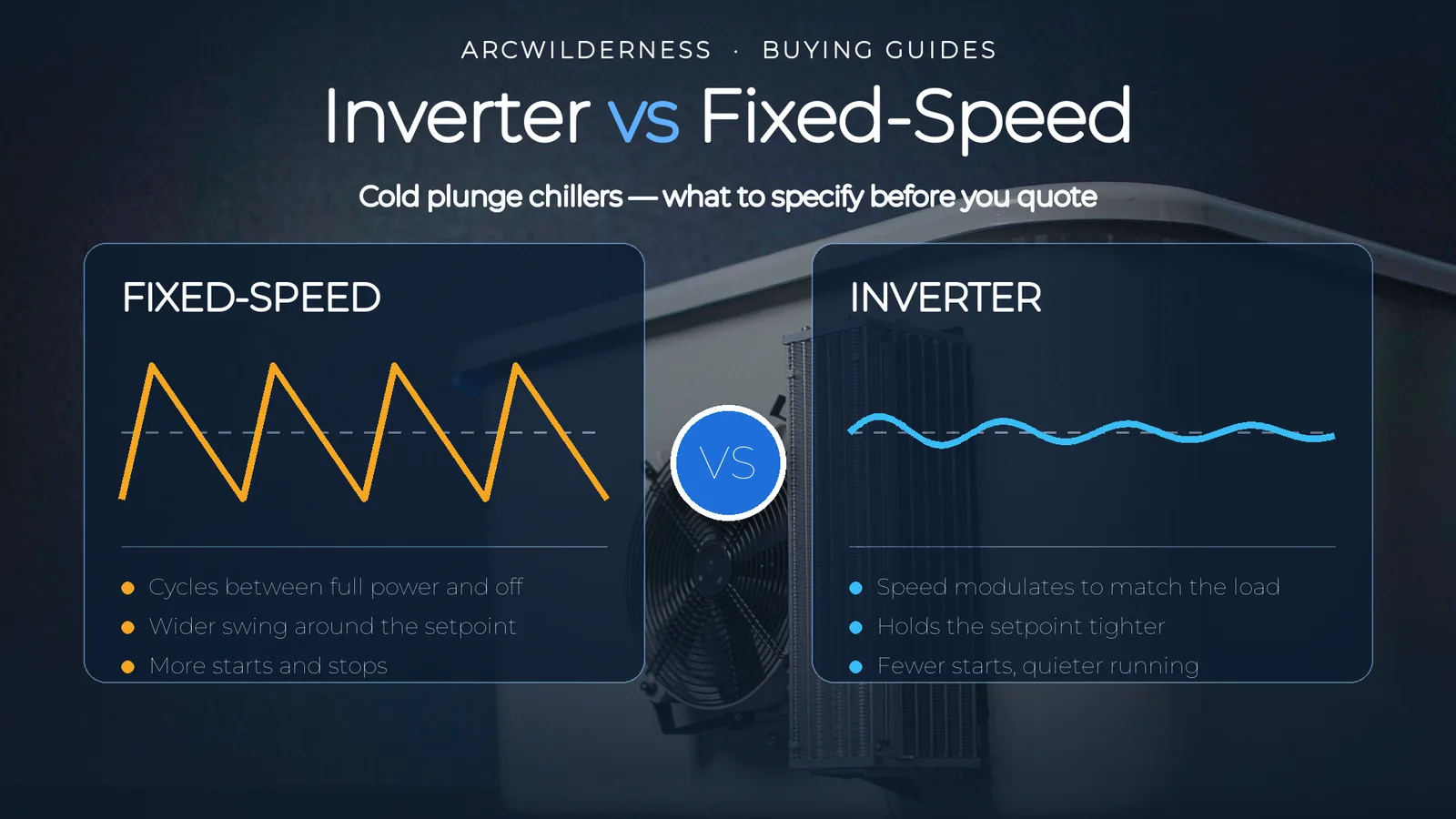
It is also an argument for buying from a manufacturer who can explain the control behaviour of the chiller, not only its horsepower.
Sources
- Machado AF et al. Can water temperature and immersion time influence the effect of cold water immersion on muscle soreness? A systematic review and meta-analysis. Sports Medicine, 2016.
- Higgins TR, Greene DA, Baker MK. Effects of cold water immersion and contrast water therapy for recovery from team sport: a systematic review and meta-analysis. Journal of Strength and Conditioning Research, 2017.
- Versey NG, Halson SL, Dawson BT. Water immersion recovery for athletes: effect on exercise performance and practical recommendations. Sports Medicine, 2013.
- Roberts LA et al. Post-exercise cold water immersion attenuates acute anabolic signalling and long-term adaptations in muscle to strength training. Journal of Physiology, 2015.
- Kox M et al. Voluntary activation of the sympathetic nervous system and attenuation of the innate immune response in humans. PNAS, 2014.
- Tipton MJ. The initial responses to cold-water immersion in man. Clinical Science, 1989.
If you are writing product copy for a cold plunge brand, send us the claims you intend to make. We will tell you what the specification can support and what the evidence does not.