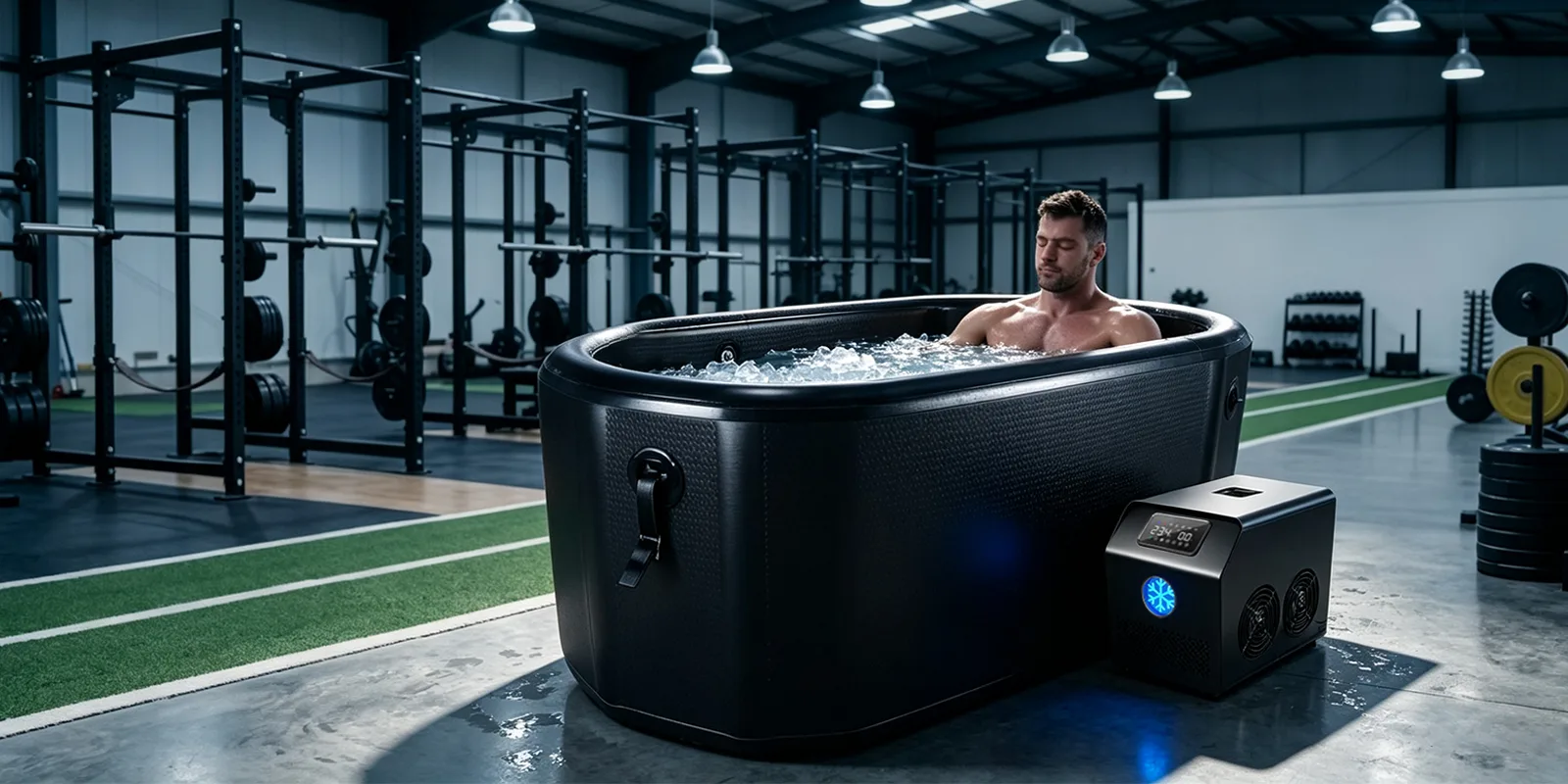
A commercial cold plunge is a cold-water immersion system installed in a facility — a gym, a recovery studio, a hotel spa, a clinic or a sports club — where several people use it in a day. That is a different engineering problem from one tub in a garden: the unit has to hold temperature through repeated bather loads, and the building has to supply the power, drainage and ventilation it needs.
Most failed installations are not chiller failures. They are site failures: a unit ordered before anyone checked the electrical supply, a tub placed where waste water cannot drain, or a chiller stacked into a cupboard that cannot reject heat.
Start with throughput, not with the tub
In a gym or recovery studio the design number is bathers per hour, not litres. Every bather adds heat to the water, and the chiller has to remove it before the next session. A 500 L tub used by two people a day is a different specification from the same tub used by thirty.
Ask the operator for three numbers: sessions per hour at peak, minutes per session, and the recovery time the business is willing to accept between sessions. Those three decide how much spare cooling capacity the site actually needs.
The ten numbers to collect before you request a quote
| Number | What to measure | Why it decides the specification |
|---|
| Tub volume | Internal water volume of the model you intend to install, in litres | Cooling load scales with water mass; our tub range runs from 320 L to 650 L |
| Target temperature | Lowest setpoint the site will use, and how tightly it must hold | Pull-down time and continuous load both depend on the gap to ambient |
| Ambient temperature | Summer temperature in the room or plant area where the chiller sits | A chiller rejects heat into the room; a hot plant room reduces capacity |
| Bathers per hour | Peak session throughput | Heat input from bathers has to be removed between sessions |
| Session length | Planned exposure time in minutes | Determines how often the chiller has to recover |
| Power supply | Voltage, single or three phase, breaker size, distance to the unit | The unit must match the supply; a plug change is not a voltage change |
| Drainage | Floor drain, floor fall, overflow route, backflow protection | Overflow and condensate need somewhere to go |
| Water supply | Fill point and flow rate | Filling a 650 L tub is a plumbing event, not a bucket job |
| Clearance | Space around the unit for airflow and service access | Manual clearances exist for a reason; enclosed plant rooms overheat |
| Delivery route | Door widths, lift size, stair turns, floor protection | A tub that cannot reach the room becomes a return shipment |
The cheapest time to discover a site problem is before the purchase order, not on installation day.
Floor loading: water weighs one kilogram per litre
A 540 L tub holds 540 kg of water before the tub, the chiller loop and the bather. On a ground-floor slab this is rarely a question. On an upper floor, a mezzanine or a temporary structure, it is a structural question for the building engineer, not for the tub supplier.
Ask for the loaded weight of the specific model and pass it to whoever signs off the floor. Do not estimate from the dry weight, and do not assume the floor is rated because a smaller tub was there before.
Power: the specification that cannot be fixed on site
Voltage, phase and breaker size are fixed by the building. A chiller can be ordered in different voltage configurations, but it cannot be converted on site by changing the plug. Confirm the supply before the unit is specified, and confirm who is responsible for the electrical connection.
Wet areas need protection appropriate to the installation: residual-current or ground-fault protection on the circuit, and equipment with an ingress protection rating suited to the location. IEC 60529 is the standard behind IP ratings — the number after IP tells you what the enclosure resists.
Keep the unit out of splash range where the layout allows, and leave service access. A chiller that has to be disconnected and carried out of the room for a filter change will not be maintained on schedule.
Drainage, ventilation and noise
- Drainage: a floor drain or defined waste route for overflow, drain-down and condensate, with backflow protection where the local code requires it
- Ventilation: the chiller moves heat from the water into the air; a closed cupboard turns the room into a heat trap and the unit derates
- Noise: ask for the sound pressure level at one metre and decide whether the unit sits next to a treatment room
- Vibration: a rigid floor and anti-vibration feet matter above occupied rooms
Water quality is part of the facility, not an afterthought
A commercial tub is shared water used by many people, so filtration, disinfection and a written cleaning schedule belong in the design. Decide who tests the water, how often, and where the record is kept before the first customer arrives.
Some jurisdictions regulate cold plunges as public pools or spas; others do not classify them at all. Check the local rule before the water treatment is specified, because the classification decides the equipment and the record-keeping.
The one-page specification to send to any supplier
Put the ten numbers above into one page, add the destination market, the certification required and the expected annual volume. A supplier who can quote against that page is answering the real question. A supplier who quotes from a photograph is guessing.
If the project covers several sites, keep the template identical across sites so the differences are visible instead of buried in email threads.
Sources
- IEC 60529 — Degrees of protection provided by enclosures (IP code).
- Tub volumes and chiller specifications quoted above come from the model pages in this catalogue, linked below.
- Local plumbing and electrical requirements: confirm with the authority having jurisdiction. The checklist lists what to ask; it is not a substitute for the local code.
Send us the ten numbers and the destination market. We will size the chiller, confirm the configuration and quote it with the documentation your market requires.