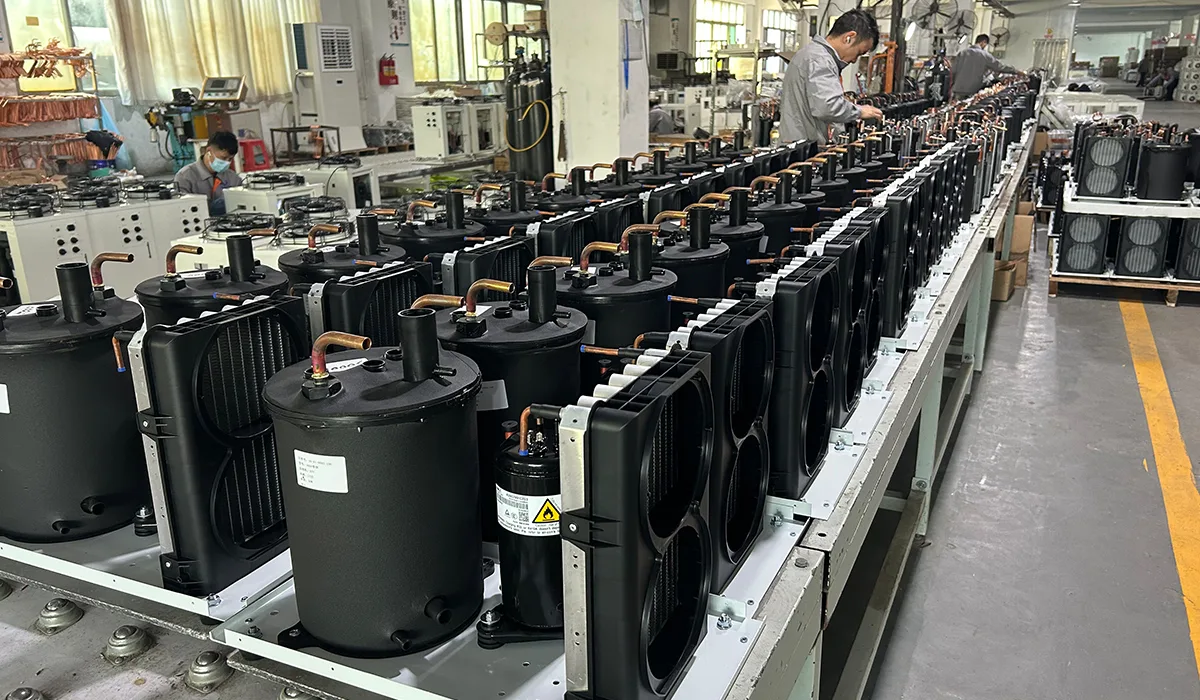
Every ice bath chiller supplier will send a catalogue, a price list and a photograph of a production line. None of those proves that the unit you order will be built the same way next quarter.
An audit is not a tour. It is a set of questions with evidence attached, asked in the same order every time so that two suppliers can be compared.
The four things you are auditing
| Dimension | The question | The evidence |
|---|
| Capability | Can they build the volume you need, in the configuration you need? | Lines, in-house processes, monthly capacity, peak-season plan |
| Consistency | Will unit 500 match unit 1? | IQC, IPQC and OQC records, calibration, final test data |
| Compliance | Can the unit be sold in your market? | Test reports, declarations, labels, certification scope |
| Continuity | Will they still supply you in two years? | Component sourcing, spare parts, warranty, service |
Capability: what is actually made in-house
Ask which processes happen on site and which are outsourced: compressor assembly, sheet metal, brazing, leak testing, controller programming and final test. A factory that assembles purchased modules is a legitimate business, but the audit questions are different from a factory that forms its own cabinets.
Ask for monthly capacity by model and the plan for peak season. A supplier who cannot state capacity in units per month is guessing.
Consistency: the paper trail
Quality is a process, not a promise. Ask to see incoming inspection records for compressors and controllers, in-process checks for brazing and leak testing, and final test data for each unit — not one certificate for a model.
If the supplier claims 100% inspection, ask what is recorded and for how long. A claim of full inspection without records is a claim about intention.
Where sampling is used instead of full inspection, the sampling plan should follow a recognised standard such as ISO 2859-1, with an acceptance quality limit that matches the risk of the component.
Compliance: reports, not logos
Certificates on a website are often logos. Ask for the test report, the declaration of conformity and the exact standard and edition. For the EU, the relevant directives include the Low Voltage Directive, the EMC Directive and RoHS; for the US, UL or ETL listings and FCC rules apply depending on the product; for Australia, the SAA mark and the applicable AS/NZS standards.
Check who is named as the manufacturer on the label and in the declaration. If the answer is the brand, the brand carries the obligation — and the supplier's files need to support it.
IEC 60335-2-40 is the safety standard commonly applied to electrical heat pumps and air-conditioning equipment. Confirm with the certification body which standard and edition apply to your chiller.
Continuity: the questions nobody asks
- Which compressor and controller brands are used, and will they be available in two years?
- What is the warranty, and who performs it in the destination market?
- Are spare parts stocked, and at what lead time?
- What happens if the controller firmware is discontinued?
- What are the MOQ and the lead time at your order volume? Our published figures are 7–15 days for samples and 25–45 days for production after sample approval.
The audit questions to take on site
- Show me the incoming inspection record for the last ten compressors.
- Show me the leak test record for the last ten units.
- Show me the calibration certificate for the pressure gauge and the temperature probe.
- Show me the final test data for a unit built last week.
- Which processes are outsourced, and who audits those suppliers?
- What is your monthly capacity, and what is committed for the next quarter?
- Which certificates do you hold, and what is the scope of each?
- Who signs the declaration of conformity?
- What is your warranty rate, and how is it measured?
- What is the spare parts lead time for a controller and a compressor?
Red flags that end the conversation
- A certificate that cannot be traced to a test report or a certification body
- A factory address that does not match the audit location
- No calibration records for measuring equipment
- A warranty that depends on the buyer paying return freight
- A price that changes after the sample is approved without a written reason
Sources
- ISO 9001:2015 — quality management systems.
- ISO 2859-1 — sampling procedures for inspection by attributes.
- IEC 60335-2-40 — safety of electrical heat pumps, air-conditioners and dehumidifiers.
- EU Low Voltage Directive 2014/35/EU, EMC Directive 2014/30/EU and RoHS Directive 2011/65/EU.
- FCC Part 15 — radio frequency devices, United States.
- Our published sampling and production windows: 7–15 days and 25–45 days.
If you are comparing suppliers, send us the audit list you are using. We will answer it in writing, with the records that apply to the models you are considering.